Elongate loach
Leptobotia elongata
Family : Botiidae
The elongate loach is a large species, threatened in its natural habitat. It requires a very large aquarium with strong current and highly oxygenated water.
Description
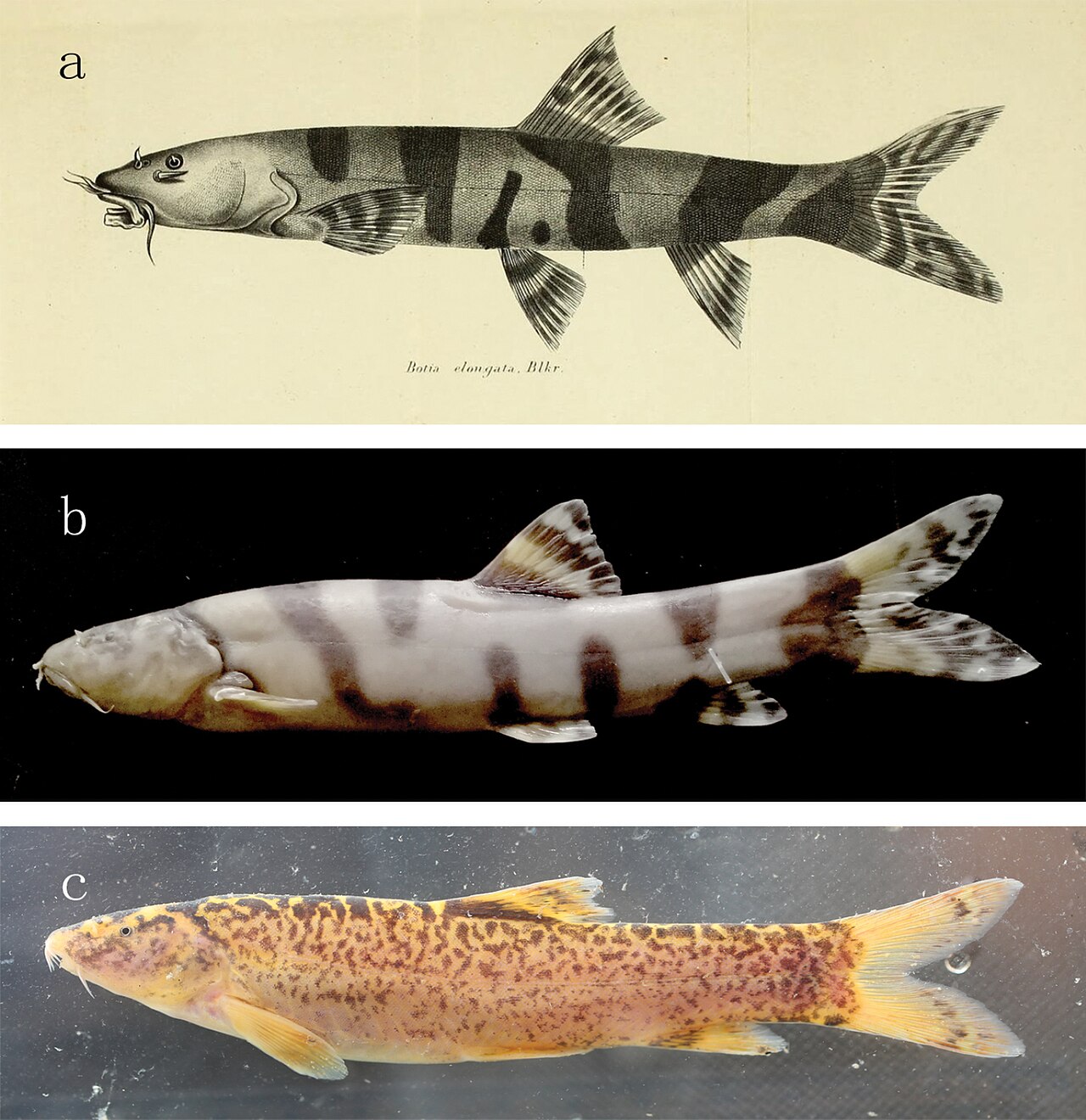
The body is very elongated and cylindrical, reaching up to 40 cm. Coloration is olive-brown to grayish with irregular dark spots. The head is small with reduced eyes. The fins are short and robust. This species is mainly nocturnal and spends the day hidden under rocks. It feeds on benthic invertebrates and small fish. In aquariums, it can become less shy if kept in a group. Its growth is slow and its lifespan exceeds 15 years. Reproduction has not been observed in captivity.
Habitat
Region :
Rivers with moderate to strong current, rocky or gravelly bottoms, clear and well-oxygenated waters.
Distribution :
Recommended parameters
Care
Care notes
A minimum 400-liter aquarium is essential for a small group of 4-6 individuals. The substrate should be smooth gravel or coarse sand. Strong current and intense oxygenation are required (powerhead). Temperature should be maintained between 18-24°C, pH 6.5-7.5, hardness 5-15 dGH. Diet is carnivorous: earthworms, mussels, shrimp, carnivore pellets. Spacious hiding places (caves, large rocks) are essential. Avoid slow-moving or long-finned fish. Water changes should be frequent (30% weekly). This species is sensitive to water quality.
Similar species
Espèces proches, même habitat ou même maintenance


