Golden Dwarf Cichlid
Nannacara anomala
Family : Cichlidae
Small dwarf cichlid with a golden body and bluish reflections, ideal for peaceful community aquariums.
Description
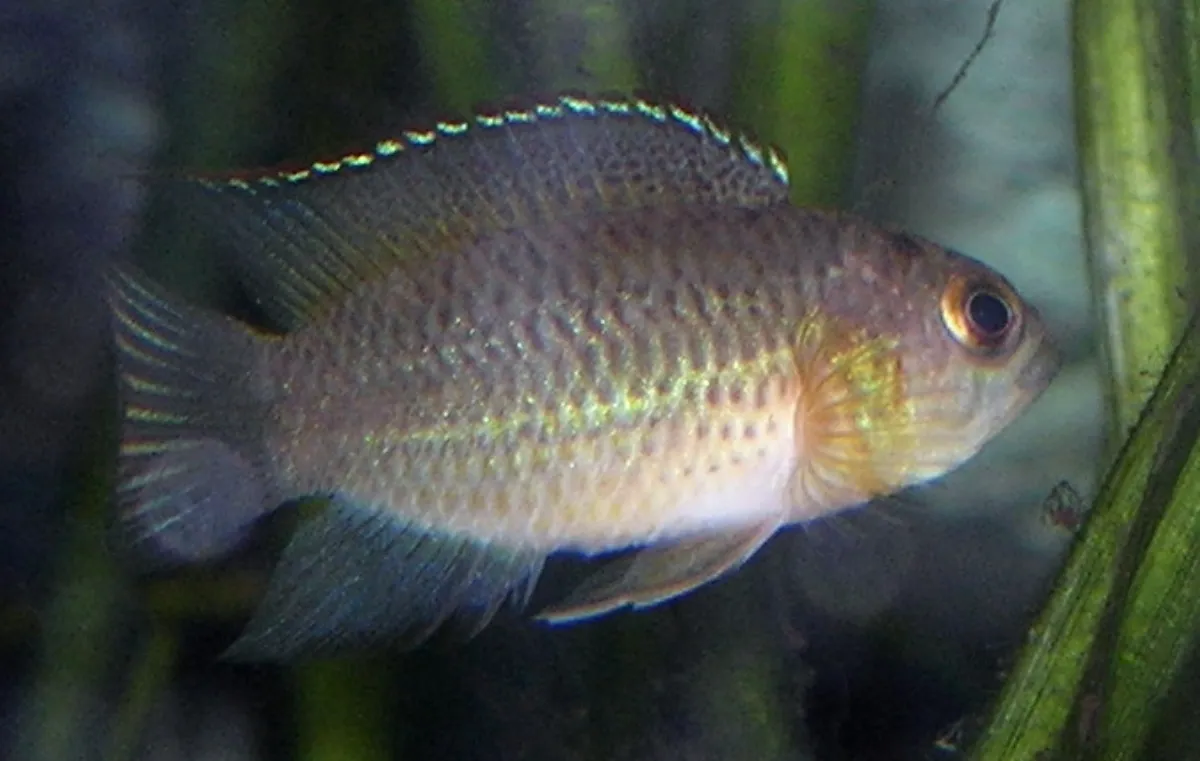
Nannacara anomala reaches about 5 to 6 cm. Its body is elongated and laterally compressed, with a golden to light brown base color, dotted with iridescent blue spots on the flanks and fins. Males are more colorful and develop pointed dorsal and anal fins. It is a peaceful fish but becomes territorial during breeding. It lives in pairs or small groups. It prefers soft, acidic water with dense vegetation and hiding places. Its reproduction is typical of dwarf cichlids: egg-laying on a hard substrate (leaf, stone) and intensive parental care.
Habitat
Region :
Calm streams, swamps and stagnant waters of Guyana, Suriname and northern Brazil
Distribution :
Recommended parameters
Care
Care notes
Keep this cichlid in an aquarium of at least 60 liters for a pair. Water should be soft (GH 2-8) and acidic (pH 6.0-7.0), with a temperature of 24-28°C. Gentle filtration and moderate lighting are recommended. Diet is omnivorous: flakes, small pellets, brine shrimp, daphnia, and frozen bloodworms. Avoid overly active or aggressive tankmates; peaceful tetras, corydoras, or small catfish are suitable. Provide hiding places with roots, stones, and plants. During breeding, the male becomes territorial but usually causes no damage. Parameters must be stable; regular water changes (20% per week) are necessary.
Similar species
Espèces proches, même habitat ou même maintenance


