Tricolor hermit crab
Clibanarius tricolor
Family : Diogenidae
Small hermit crab with legs striped in blue, red, and yellow, very popular in marine aquariums as an algae cleaner.
Description
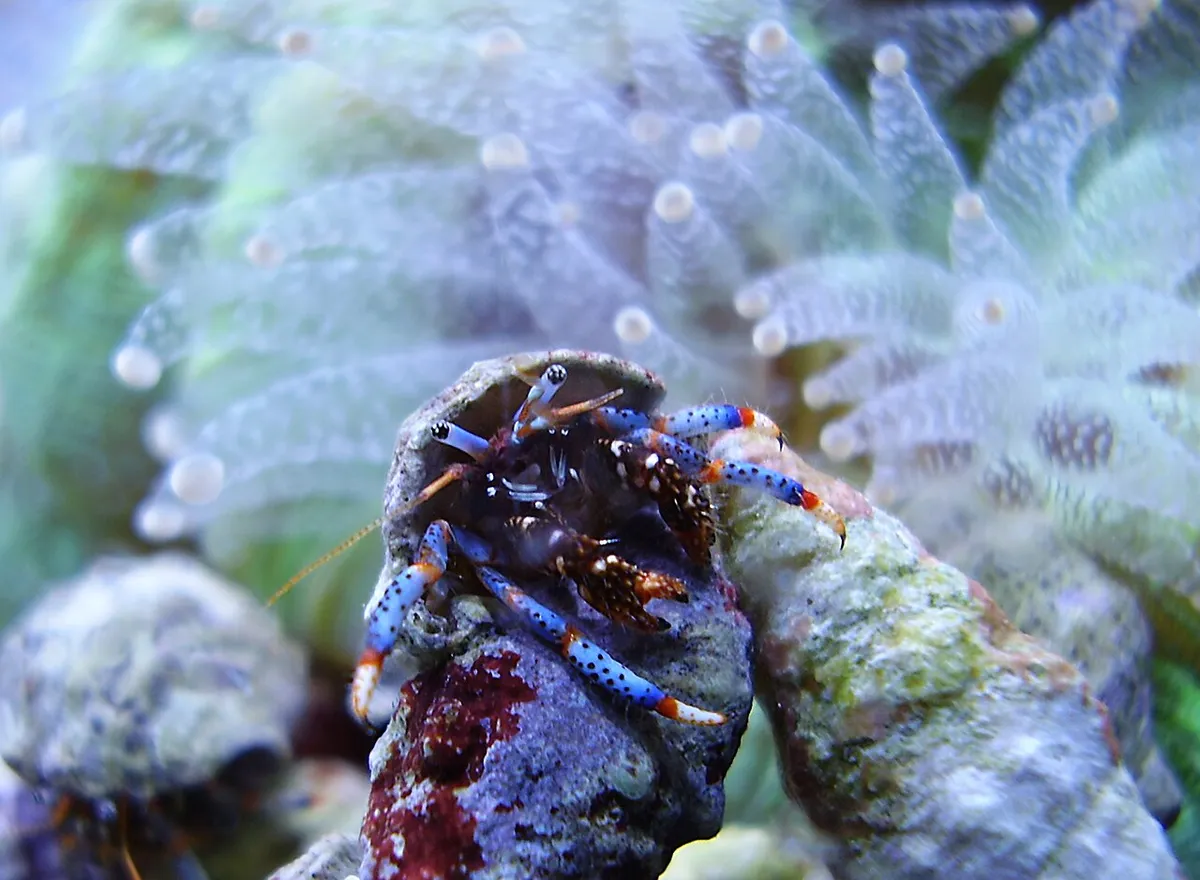
Clibanarius tricolor reaches up to 2.5 cm in length (including shell). Its legs are adorned with alternating blue, red, and yellow bands, and its claws are often blue with white tips. The body is soft and asymmetrical, adapted to living inside a shell. It is an active scavenger that moves quickly across the substrate. Males have larger claws than females, but sexual dimorphism is subtle.
Habitat
Region :
This hermit crab inhabits shallow waters of coral reefs and rocky areas in the Caribbean. It is often found on sandy bottoms or among coral rubble, searching for empty shells for protection. It is most active at night and hides in crevices during the day.
Distribution :
Recommended parameters
Care
Care notes
A tank of at least 10 gallons (40 L) is recommended for a small group. Water should be maintained at 22-28°C, pH 8.1-8.4, salinity 1.023-1.025. Provide a sandy substrate and plenty of empty shells of various sizes to allow shell changes. It is omnivorous, feeding on algae, detritus, and leftover food; it also accepts shrimp pellets and dried seaweed. Generally peaceful but may attack small snails for their shells. Iodine supplementation is needed to support molting.
Similar species
Espèces proches, même habitat ou même maintenance


