Cleaner wrasse
Labroides dimidiatus
Family : Labridae
The cleaner wrasse is a small marine reef fish famous for its cleaning behavior, removing parasites and dead tissue from other fish.
Description
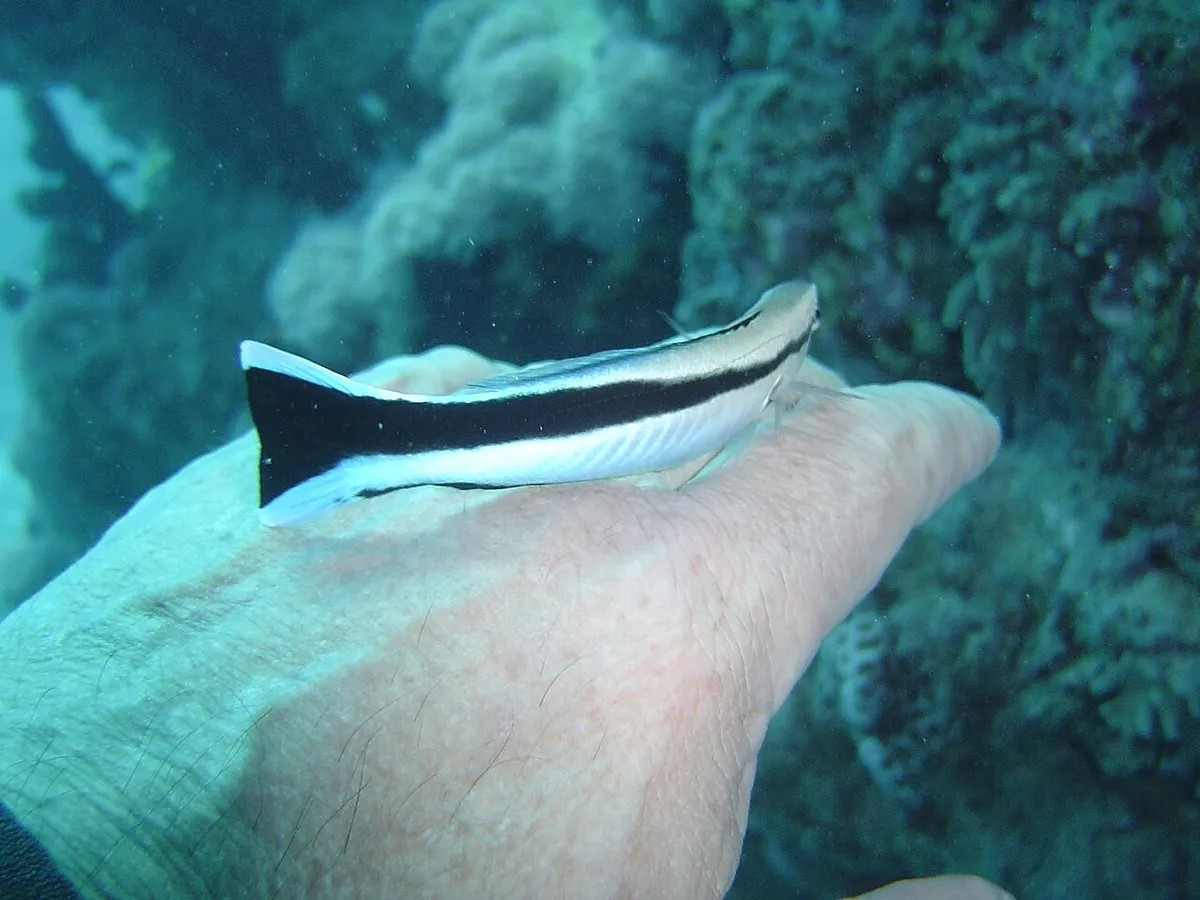
Labroides dimidiatus reaches a maximum size of about 12 cm. Its body is elongated and laterally compressed, with a characteristic coloration: a horizontal black stripe on a light blue to white background, and a bright yellow tail. The fins are translucent with bluish reflections. It is a very active diurnal fish, known for its mutualistic cleaning behavior. Sexual dimorphism is slight: males are slightly larger and more colorful than females, and individuals can change sex (protogyny).
Habitat
Region :
This fish inhabits tropical coral reefs, where it establishes cleaning stations on corals or rocks. It is often found in small groups or solitary, waiting for other fish to come for cleaning. It frequents clear, shallow waters, typically between 1 and 30 meters depth.
Distribution :
Recommended parameters
Care
Care notes
A tank of at least 200 liters is recommended, with stable water parameters (temperature 24-28°C, pH 8.1-8.4, salinity 1.020-1.025). A rocky setup with hiding places is essential. This fish is a strict carnivore: it must be fed several times a day with small meaty foods (brine shrimp, mysis, chopped krill). It is compatible with most reef fish, but can be aggressive towards other cleaner wrasses. Caution: it may starve if the aquarium does not have enough client fish or if the diet is inadequate. It is sensitive to water quality fluctuations.
Similar species
Espèces proches, même habitat ou même maintenance


