Lobed brain coral
Lobophyllia hemprichii
Family : Lobophylliidae
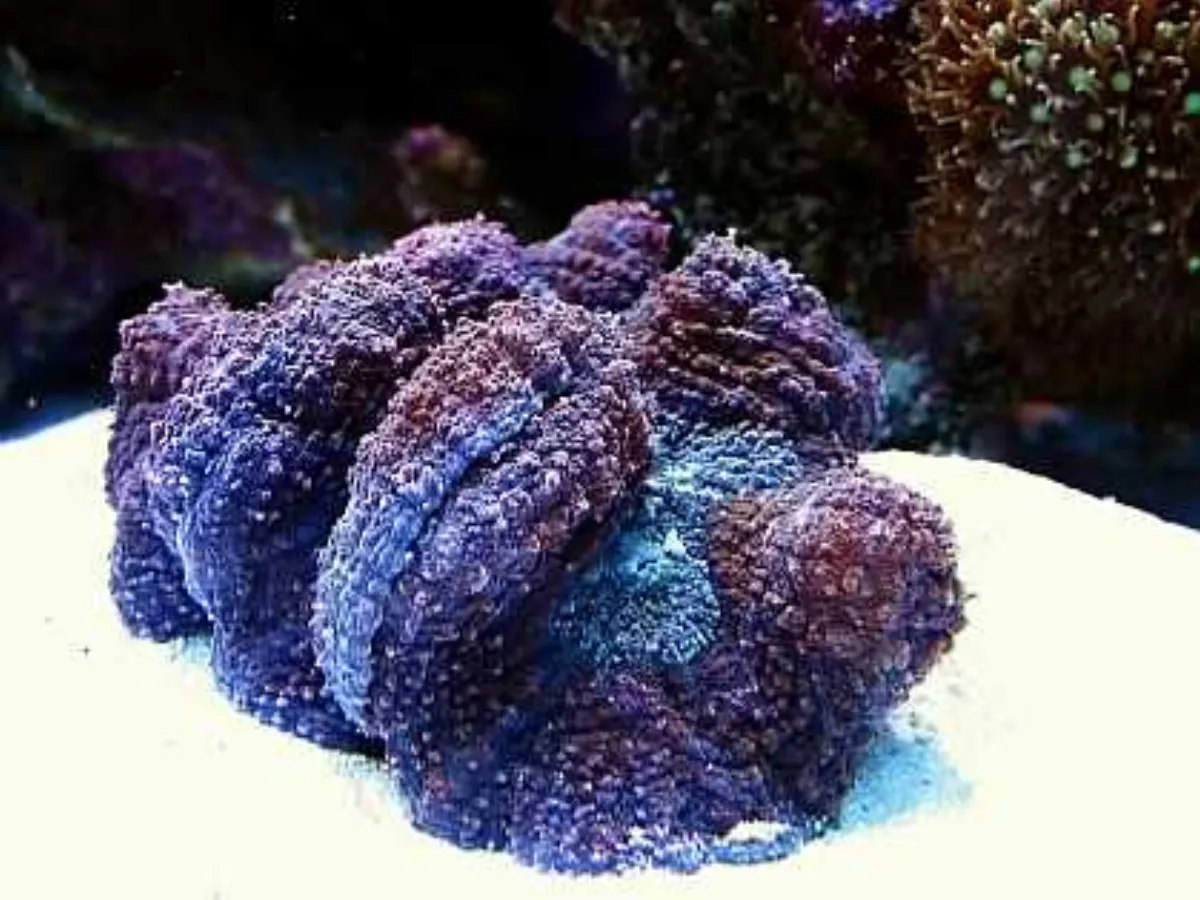
Lobophyllia hemprichii is a massive LPS coral, recognizable by its large fleshy polyps and varied colors. It is popular in reef aquariums.
Description
Colonies of Lobophyllia hemprichii are massive, hemispherical or encrusting, reaching up to 30 cm in diameter. Polyps are large, fleshy, with short, swollen tentacles, often brightly colored (green, brown, red, purple). The corallite surface has well-visible septa. At night, sweeper tentacles may extend to capture prey. No obvious sexual dimorphism.
Habitat
Region :
This coral is found mainly on reef slopes and shallow lagoons, often in areas with moderate sedimentation. It prefers hard substrates and can form large hemispherical colonies. It occurs at depths between 1 and 30 meters.
Distribution :
Recommended parameters
Care
Care notes
A minimum tank size of 100 liters is recommended. Lighting should be moderate to intense, with moderate water flow to prevent debris accumulation on polyps. Water parameters must be stable: temperature 24-27°C, pH 8.1-8.4, salinity 1.023-1.025, calcium >400 mg/L, magnesium >1250 mg/L, alkalinity 8-12 dKH. It tolerates nitrates up to 10 mg/L and phosphates up to 0.1 mg/L. It is semi-aggressive: its sweeper tentacles can damage neighboring corals, so spacing of at least 15 cm is advised. It feeds on zooplankton and small particles but derives most energy from its zooxanthellae.
Similar species
Espèces proches, même habitat ou même maintenance


