Capricorn montipora
Montipora capricornis
Family : Acroporidae
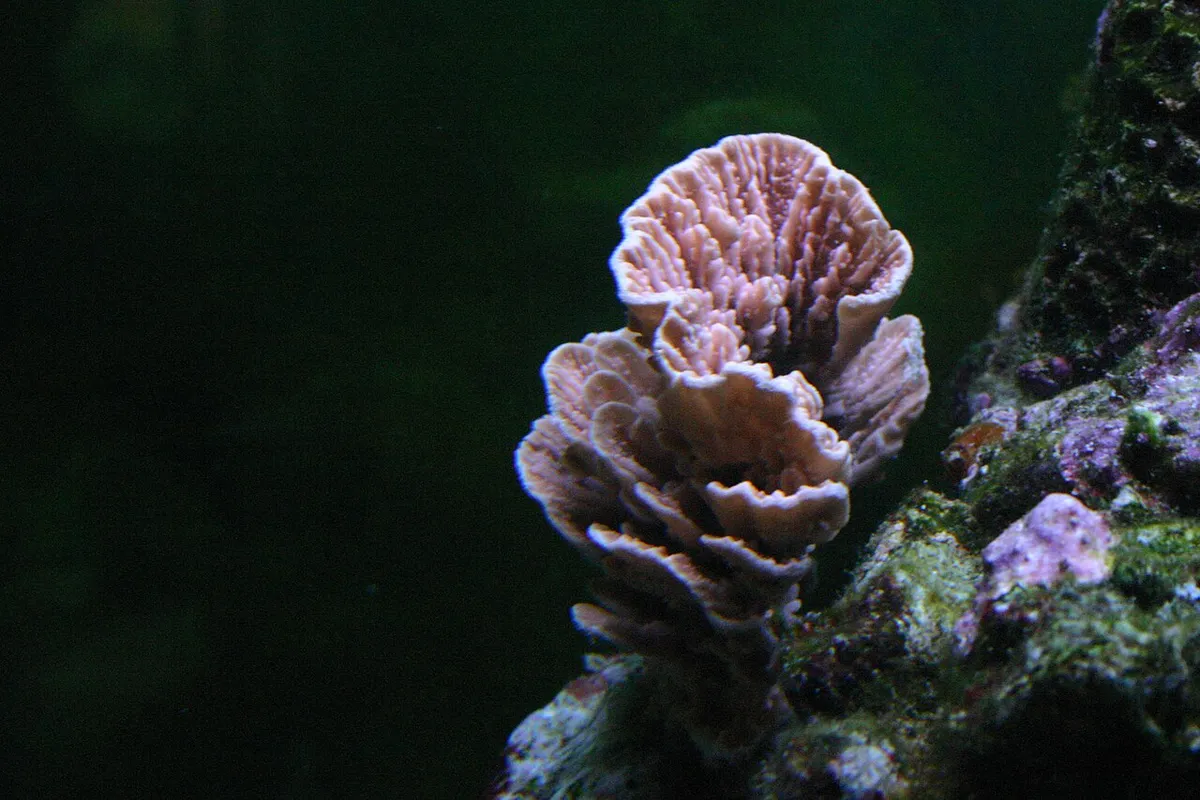
The Capricorn montipora is an SPS coral recognizable by its twisted horn-shaped or plate-like colonies. It is highly prized in reef aquariums for its fast growth and vibrant colors.
Description
Montipora capricornis forms massive or encrusting colonies, often as horizontal plates or upright twisted horns. The polyps are very small (less than 1 mm) and retractile, giving a velvety texture. Coloration ranges from green, brown, pink to purple, often with lighter edges. Corallites are immersed in the coenosteum with indistinct walls. There is no obvious sexual dimorphism, but reproduction is both sexual and asexual via fragmentation.
Habitat
Region :
Montipora capricornis is found on shallow reef slopes, often in areas with strong current and intense light. It forms plate-like or twisted horn-shaped colonies, encrusting hard substrates. The species is common in clear lagoons and fringing reefs. It prefers oligotrophic, well-oxygenated waters.
Distribution :
Recommended parameters
Care
Care notes
A tank of at least 100 liters is recommended, with intense lighting (LED or metal halide) and moderate to strong flow. Parameters must be stable: temperature 24-28°C, pH 8.1-8.4, salinity 1.023-1.025, calcium >400 mg/L, magnesium >1300 mg/L, KH 8-12 dKH. Nitrates should stay below 5 mg/L and phosphates below 0.03 mg/L. It feeds mainly through photosynthesis, but supplementation with phytoplankton or liquid coral food is beneficial. Beware of polyp stings when handling, and avoid placing it too close to aggressive corals.
Similar species
Espèces proches, même habitat ou même maintenance


