Ramshorn snail
Planorbarius corneus
Family : Planorbidae
A small freshwater snail with a flat spiral shell, very common in the aquarium hobby. It is valued as a cleaner and for its ease of breeding.
Description
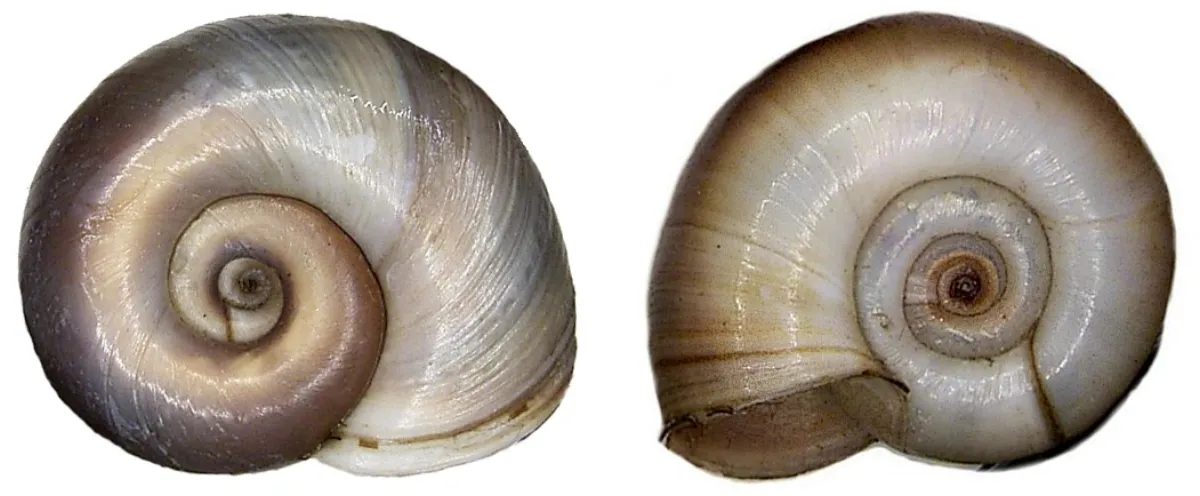
The ramshorn snail has a reddish-brown discoid shell coiled in a single plane, reaching up to 3 cm in diameter. Its body is dark brown with fine, triangular tentacles. It breathes using a lung sac, allowing it to survive in oxygen-poor waters. It is a hermaphroditic mollusk capable of self-fertilization. It moves slowly across surfaces, scraping algae and detritus. In an aquarium, it can multiply quickly if food is abundant. Its shell is fragile and may break if handled roughly.
Habitat
Region :
The ramshorn snail is found in stagnant or slow-moving waters: ponds, marshes, ditches, and shallow lakes. It thrives in areas rich in aquatic vegetation where it can feed on organic debris. The substrate is often muddy or sandy, and the water is typically hard.
Distribution :
Recommended parameters
Care
Care notes
The ramshorn snail is very easy to keep in a freshwater aquarium. A temperature between 18 and 25 °C and a neutral to slightly alkaline pH (7.0–8.0) are suitable. It tolerates a wide range of hardness. No special lighting is required. It feeds on algae, leftover food, and decaying plant matter. Avoid copper-based medications, which are toxic to invertebrates. It can be kept alone or in groups, and cohabits peacefully with most fish. Be careful not to overfeed to avoid a population explosion.
Similar species
Espèces proches, même habitat ou même maintenance


