Moon wrasse
Thalassoma lunare
Family : Labridae
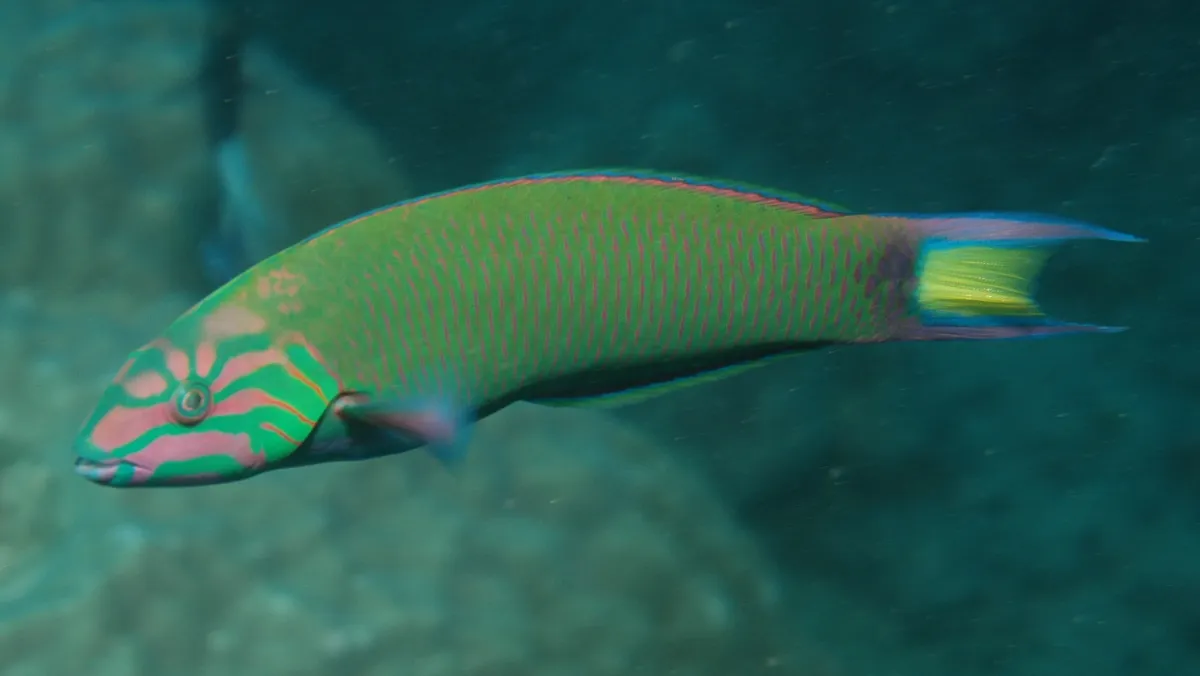
The moon wrasse is a colorful reef fish from the Indo-Pacific, recognizable by its crescent-shaped tail. It is active and popular in marine aquariums.
Description
The moon wrasse reaches a maximum size of about 25 cm. Its body is elongated and laterally compressed. Adult males display a bright blue-green coloration with a yellow tail marked by a black crescent-shaped spot. Females and juveniles are duller, often olive green or brownish. It is a very active diurnal fish that swims constantly in search of food. Sexual dimorphism is pronounced: males are larger and more colorful than females.
Habitat
Region :
This fish inhabits coral reefs, lagoons, and outer reef slopes. It is often found in clear water between 1 and 30 meters depth. It frequents areas rich in corals and rocks where it can hide. Juveniles prefer shallow, sheltered zones.
Distribution :
Recommended parameters
Care
Care notes
A tank of at least 300 liters is recommended for an adult specimen, with plenty of open swimming space and live rock for hiding. Temperature should be maintained between 24 and 28 °C, pH between 8.1 and 8.4, and salinity between 1.020 and 1.025. This fish is carnivorous and accepts a variety of meaty foods (shrimp, mussels, fish). It can be aggressive towards small fish and invertebrates, so it is not suitable for reef tanks. Strong filtration and regular water changes are necessary.
Similar species
Espèces proches, même habitat ou même maintenance


