Bicolor angelfish
Centropyge bicolor
Family : Pomacanthidae
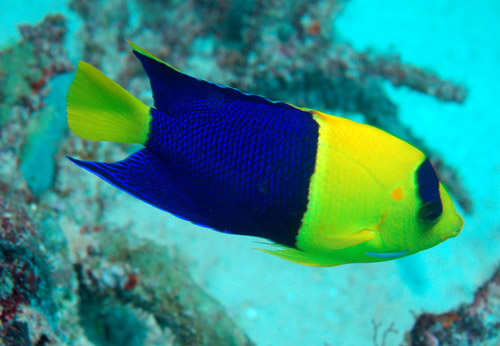
The bicolor angelfish is a small dwarf angelfish very colorful, with a yellow front half and a dark blue rear half. It is popular in reef aquariums but can be territorial.
Description
This dwarf angelfish reaches about 15 cm in adulthood. Its distinctive coloration makes it easily recognizable: the head and anterior part of the body are bright yellow, while the posterior part and caudal fin are dark blue. The dorsal and anal fins are edged in blue. It has a laterally compressed body and a small mouth. It is an active fish that constantly explores rocks in search of food. It can be aggressive towards other angelfish and similarly shaped fish. In the aquarium, it adapts well but requires a varied diet.
Habitat
Region :
Coral reefs, lagoons and rocky areas
Distribution :
Recommended parameters
Care
Care notes
Temperature 24-28°C, pH 8.1-8.4, salinity 1.020-1.025. A minimum tank volume of 200 liters is recommended. The aquarium should have plenty of live rock for grazing and hiding places. It is omnivorous with a herbivorous tendency: offer algae (nori, spirulina), mysis, brine shrimp, and angelfish pellets. It can be kept alone or as a pair in a large tank. Avoid housing it with other Centropyge or overly passive fish. It may nip at soft corals and polyps, so monitoring is needed. Good filtration and regular water changes are essential. It is sensitive to water quality, especially nitrates.
Similar species
Espèces proches, même habitat ou même maintenance


