Florida ricordea
Ricordea florida
Family : Ricordeidae
The Florida ricordea is a small solitary or colony-forming soft coral, popular in reef aquariums for its bright colors and ease of care.
Description
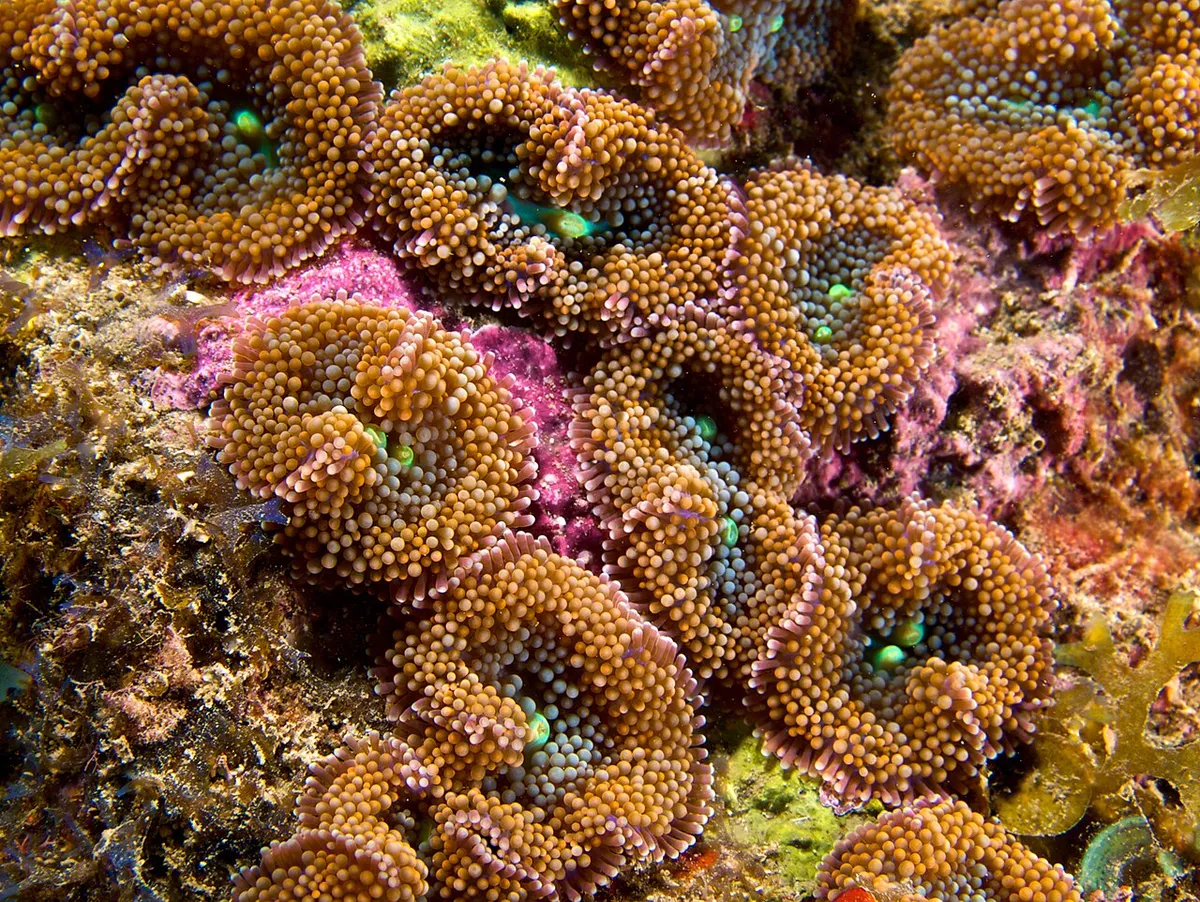
Ricordea florida is a soft coral of the family Ricordeidae, reaching up to 5 cm in diameter per polyp. Its oral disc is covered with short, bulbous tentacles often arranged in concentric rows. Coloration is highly variable: green, blue, orange, pink, or multicolored with contrasting patterns. It occasionally forms small colonies through budding. No obvious sexual dimorphism, but asexual reproduction by fragmentation is common.
Habitat
Region :
Ricordea florida is found in shallow reef waters of Florida and the Caribbean. It colonizes hard substrates, coral rubble, and rocks, often in areas with low water flow. The species thrives under moderate light and in clear, well-oxygenated water.
Distribution :
Recommended parameters
Care
Care notes
A tank of at least 20 liters is sufficient for a single polyp, but 40 liters is recommended for a small group. Temperature should be kept between 24–28 °C, pH 8.1–8.4, and salinity 1.023–1.025. Moderate lighting and low to moderate flow are ideal. Ricordea florida is photosynthetic but will accept fine foods such as phytoplankton or micro-particles. It is compatible with most reef fish and invertebrates, but sensitive to high nitrate and phosphate levels.
Similar species
Espèces proches, même habitat ou même maintenance


