Yuma ricordea
Ricordea yuma
Family : Ricordeidae
Ricordea yuma is a solitary or colonial soft coral, popular in reef aquariums for its bright colors and ease of care.
Description
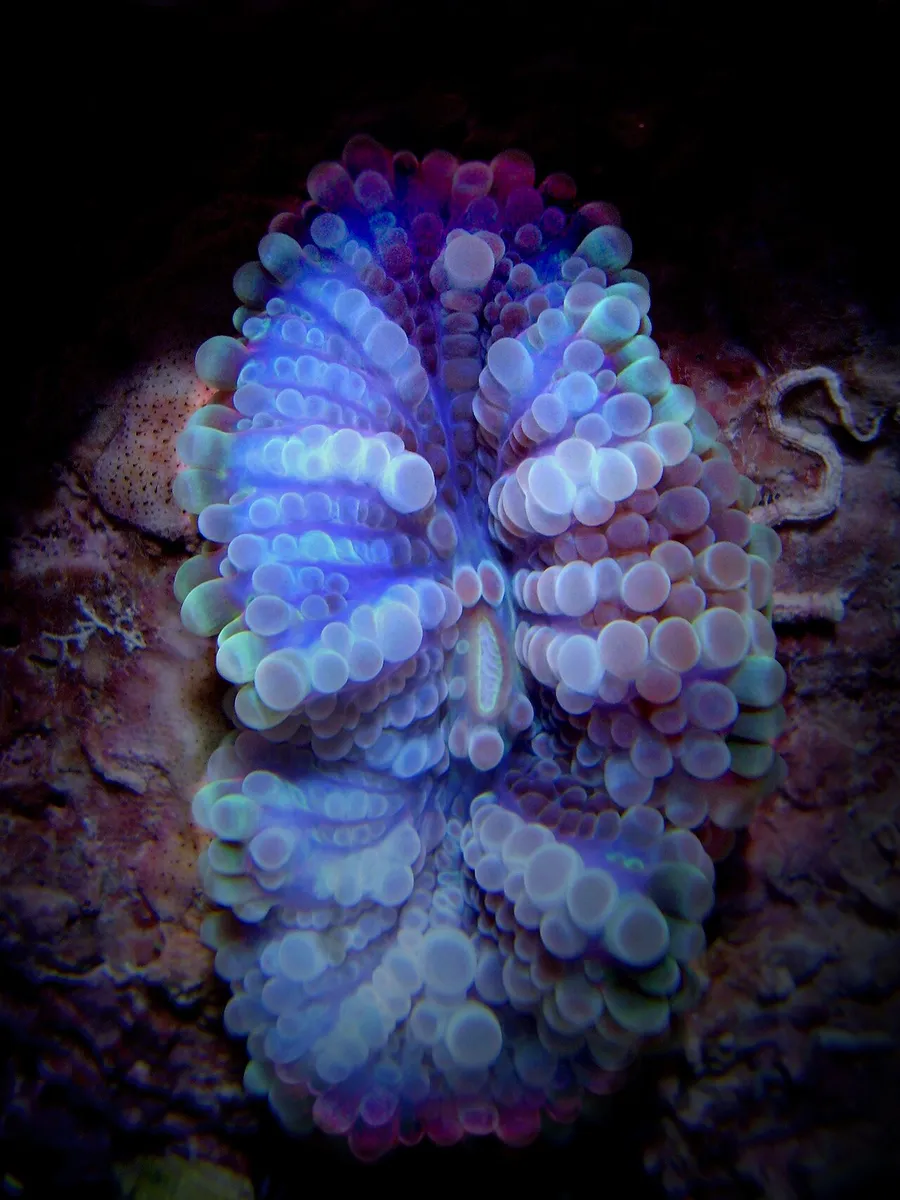
Ricordea yuma appears as fleshy polyps, typically 5 to 15 cm in diameter. Its surface is covered with short, bulbous tentacles often arranged in concentric patterns. Coloration is extremely variable: green, blue, orange, red, purple, often with contrasting patterns. It has a central mouth surrounded by longer tentacles. It is photosynthetic thanks to its zooxanthellae, but can also capture small prey. There is no obvious sexual dimorphism, but asexual reproduction by budding is common.
Habitat
Region :
Ricordea yuma is found on shallow coral reefs, often attached to hard substrates such as rocks or coral rubble. It prefers calm areas with moderate to low light, sheltered from strong currents. It can form dense colonies in lagoons and reef slopes. The species is often associated with clear, oligotrophic waters.
Distribution :
Recommended parameters
Care
Care notes
A tank of at least 80 liters is recommended for one specimen, with low to moderate lighting and low to moderate flow. Water parameters must be stable: temperature 24-27°C, pH 8.1-8.4, salinity 1.023-1.025, calcium 400-450 ppm, magnesium 1250-1350 ppm, dKH 8-12. It tolerates nitrates up to 10 ppm and phosphates up to 0.1 ppm. It feeds mainly through photosynthesis but appreciates fine meaty foods like zooplankton or mysis. Beware of stinging tentacles: leave at least 10 cm of space from other corals. Avoid fish or invertebrates that might jostle it.
Similar species
Espèces proches, même habitat ou même maintenance


