Millepora coral
Acropora millepora
Family : Acroporidae
Acropora millepora is a highly sought-after SPS coral in reef aquaria for its vibrant colors and fast growth. It requires intense lighting and high water quality.
Description
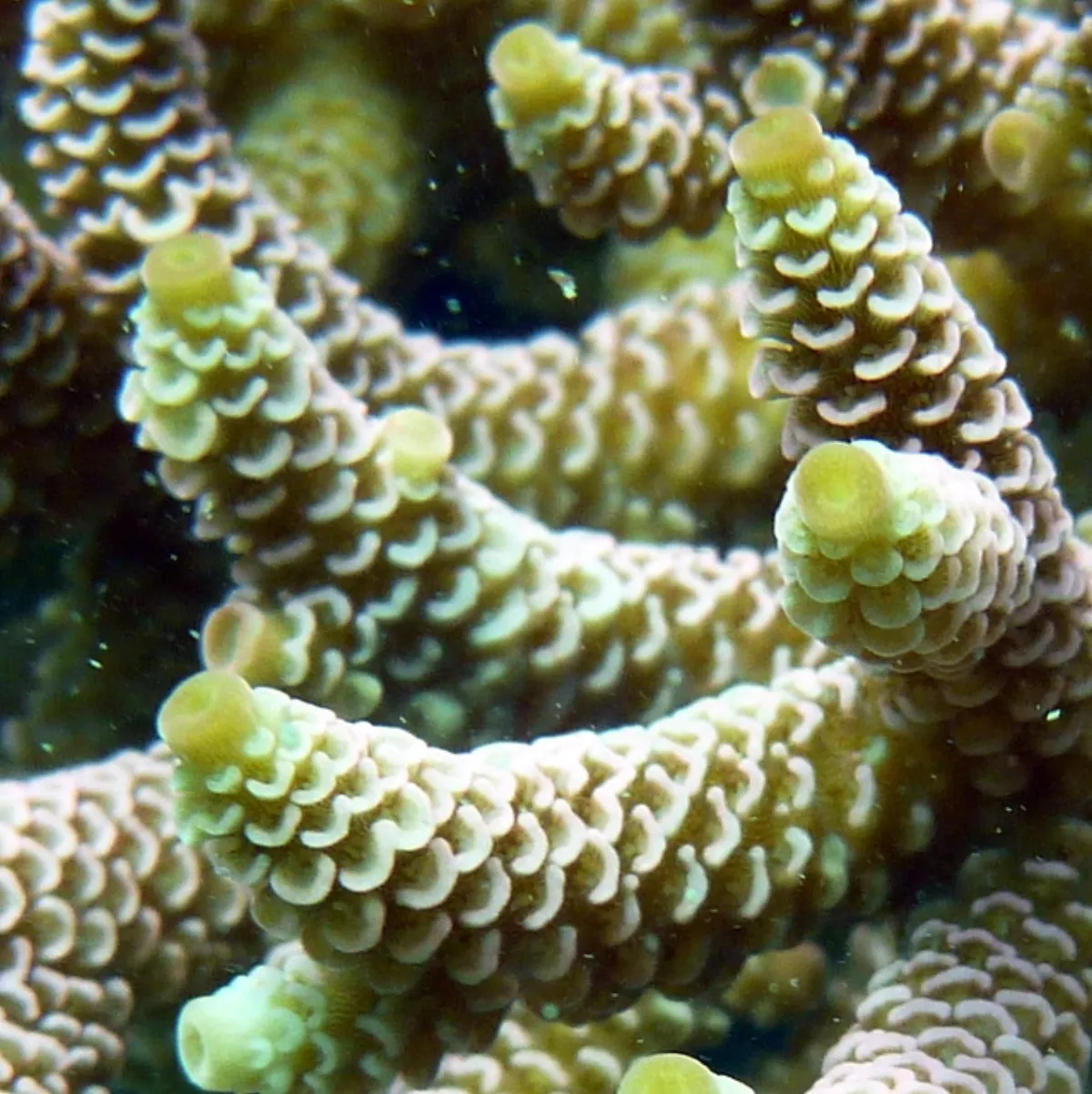
Acropora millepora forms arborescent or bushy colonies with thin, pointed branches. The polyps are small and retractable, giving a velvety appearance to the surface. Its coloration ranges from green to brown, with tips often blue, purple, or pink. It is a fast-growing coral that can reach 30 cm in diameter in aquaria. It exhibits limited sexual dimorphism, with colonies generally being gonochoric. In aquaria, it can develop intense colors under appropriate lighting.
Habitat
Region :
Acropora millepora is primarily found in shallow coral reefs of clear, well-lit waters in the Indo-Pacific. It colonizes areas of high water energy, such as reef slopes exposed to surge. It is often found in lagoons and reef flats, forming dense branching colonies. It prefers oligotrophic waters with low nutrient levels.
Distribution :
Recommended parameters
Care
Care notes
A minimum tank size of 100 liters is recommended for a small frag, but a 200+ liter tank is better for a mature colony. Water parameters must be stable: temperature 24-27°C, pH 8.1-8.4, salinity 1.024-1.026, dKH 8-12, calcium 400-450 ppm, magnesium 1300-1400 ppm. Intense lighting (LED or metal halide) is essential, along with strong flow to bring nutrients and remove waste. It is sensitive to parameter swings and high nitrates/phosphates. Compatible with most reef fish, but avoid coral-eating fish. Propagation is done by fragging branches.
Similar species
Espèces proches, même habitat ou même maintenance


