Open brain coral
Trachyphyllia geoffroyi
Family : Trachyphylliidae
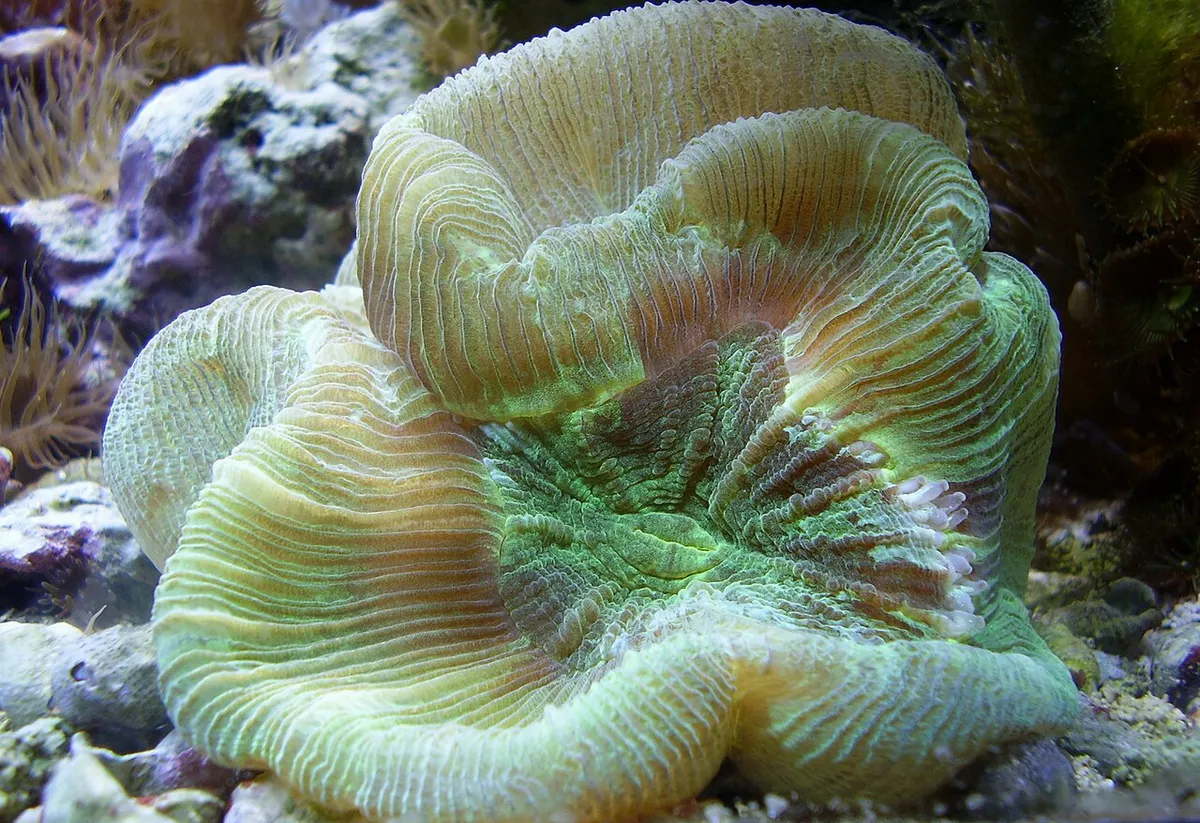
The open brain coral is an LPS coral with large fleshy polyps, recognizable by its undulating shape and vivid colors. It is popular in reef aquariums for its relative hardiness.
Description
Trachyphyllia geoffroyi forms massive, rounded or elongated colonies up to 30 cm in diameter. The polyps are large and fleshy, with short tentacles and visible mouths. Coloration ranges from green, brown, red, orange to purple, often with contrasting patterns. It is generally solitary but can coexist with other corals at a distance. No obvious sexual dimorphism.
Habitat
Region :
This coral is found mainly on reef slopes and sandy lagoon areas, often in turbid waters. It can form large rounded or dome-shaped colonies anchored in soft substrate. It occurs between 1 and 30 meters depth.
Distribution :
Recommended parameters
Care
Care notes
A tank of at least 100 liters is recommended, with moderate to intense lighting and low to moderate flow. Stable parameters are essential: temperature 24-27°C, pH 8.1-8.4, salinity 1.023-1.025, calcium >400 ppm, magnesium >1200 ppm, KH 8-12 dKH. It tolerates nitrates up to 20 ppm and phosphates up to 0.1 ppm. It feeds on zooplankton and can be target-fed meaty foods. Beware of stinging tentacles at night; space it at least 15 cm from other corals.
Similar species
Espèces proches, même habitat ou même maintenance


